Honest advice · Restore vs replace
Should you replace or restore your patio, driveway or render?
By Andrew · Power Wash Pro, Thame
"Should I just replace it?" is one of the most common questions I get asked. When a patio, driveway or render looks beyond hope, it's easy to assume replacement is the only option.
But after restoring hundreds of surfaces across Thame and the surrounding villages, I can tell you honestly — restoration is almost always the answer.
A proper clean, the right treatment, and a bit of re-sanding or sealing can bring a surface back to life — at a fraction of the cost of ripping it out and starting again.
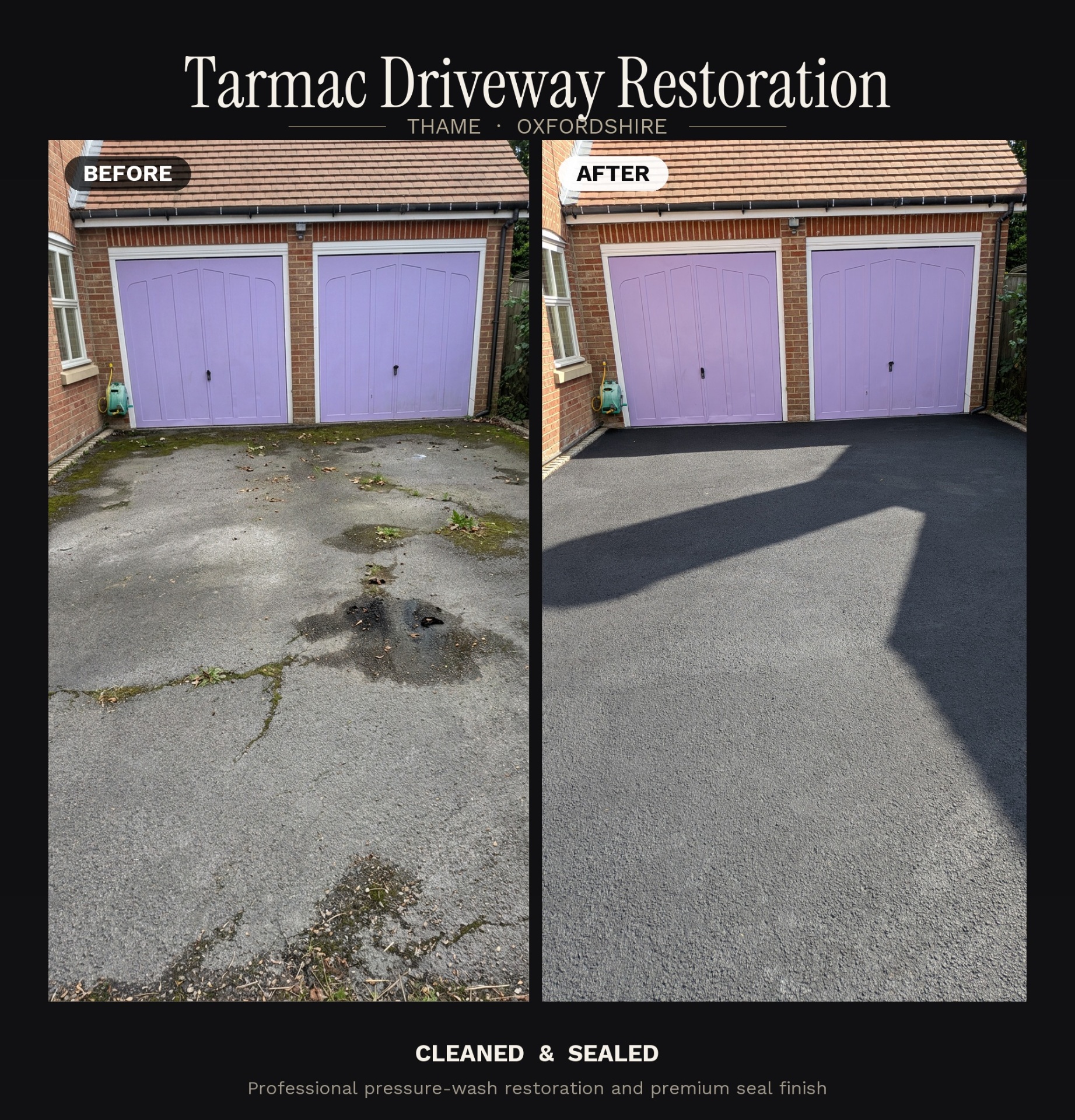
I've been surprised myself by the results. Recently, a faded, mossy tarmac drive in Thame looked practically brand new after a careful soft-wash and tarmac restorer. No replacement needed, no weeks of disruption, no five-figure quote.
Unless there's genuine structural damage — heaving slabs, a failing sub-base, or render that's lifting away from the wall — restoration is usually the smarter, faster choice.
And because I don't do replacement work, I've no incentive to sell you one. If your surface genuinely needs replacing, I'll tell you straight and point you toward a good local landscaper.
Restoration usually wins when…
These are the signs I can bring it back.
- Moss, algae, black spot or green film on the surface — cosmetic, not structural.
- Faded tarmac, block paving or slabs that have lost their colour and depth.
- Weeds and loose kiln-dried sand in the joints — a clean and re-sand fixes it.
- Render with green or black staining, but the substrate is still sound and firmly attached.
- Patio slabs that are level and intact — just dirty, stained or slippery.
Replacement makes more sense when…
These are structural problems, not cleaning problems.
- Slabs are heaving, sunken or rocking — the sub-base has failed.
- Deep, spreading cracks across a driveway or large sections of paving.
- Render that's blown, hollow-sounding or physically lifting away from the wall.
- Tarmac that's crumbling, potholed or badly broken up.
Before you replace, let's talk about restoring.
Send a couple of photos or a short walk-around video and I'll tell you honestly whether it's a restoration job or a replacement one — same-day fixed quote wherever possible, no pushy calls.
Common questions
Is it cheaper to restore or replace a driveway or patio?
In almost every case, restoration is a fraction of the cost of replacement. A full driveway or patio replacement in Oxfordshire & Bucks typically runs into thousands, whereas a professional clean, treatment and re-sand or seal usually falls between £285 and £685 for most homes.
Can a tarmac driveway really be restored?
Yes. A careful soft-wash to lift moss and algae, followed by a proper tarmac restorer, brings faded tarmac back to a deep, near-black finish. We recently did exactly this on a driveway in Thame that the owner assumed needed replacing.
When does a surface actually need replacing?
Structural damage is the deciding factor — heaving, deep cracks, sunken bays, failing sub-base, or blown render that's lifting away from the wall. Surface staining, moss, algae, black spot, weeds in the joints and general fading are all restoration jobs, not replacement jobs.
How do I know which one my patio or driveway needs?
Send me a couple of photos or a short walk-around video on WhatsApp (07418 609664). I'll tell you honestly whether it's a restoration job or whether you'd be better off getting a landscaper's quote — I don't do replacement work, so there's no incentive to sell you a clean you don't need.
How long does a restored surface stay looking good?
With a proper clean, joint refresh and — where suitable — a sealer or restorer, most patios and driveways look excellent for 2–4 years before they need another light maintenance clean. Render treated with a soft-wash biocide typically stays clean for 3–5 years.